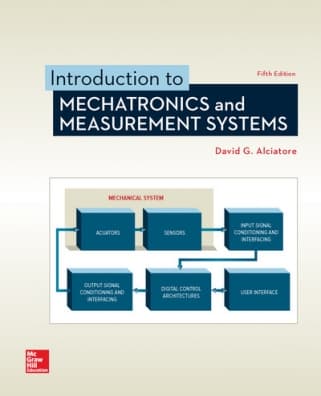
Introduction to Mechatronics and Measurement Systems, 5/e
- 저자
- David G. Alciatore
- 출간
- 2018-01-11
- ISBN
- 9781266133909
- 형태
- 전자책 · 0 · 기타 · 588쪽
- 가격
- 55,000 원
책 소개
Introduction to Mechatronics and Measurement Systems, Fifth Edition, provides comprehensive and accessible coverage of the field of mechatronics for mechanical, electrical and aerospace engineering majors. The author presents a concise review of electrical circuits, solid-state devices, digital circuits, and motors- all of which are fundamental to understanding mechatronic systems.
Mechatronics design considerations are presented throughout the text, and in "Design Example" features. The text's numerous illustrations, examples, class discussion items, and chapter questions & exercises provide an opportunity to understand and apply mechatronics concepts to actual problems encountered in engineering practice. This text has been tested over several years to ensure accuracy.
Introduction to Mechatronics and Measurement Systems, Fifth Edition - is a multifaceted resource which is designed to serve as a text for modern instrumentation and measurements courses, hybrid electrical and mechanical engineering courses replacing traditional circuits and instrumentation courses, as well as for stand-alone mechatronics courses, or the first course in a mechatronics sequence. It can also work for hybrid courses, providing an opportunity to reduce the number of credit hours in a typical mechanical engineering curriculum. Written by the academic award winning author and mechanical engineering professor, Dr. David G. Alciatore.
The author's webpage (linked to from OLC) has additional computer files and resources, including MATLAB examples, videos demonstrations, and lab exercises.
목차
Lists
Class Discussion Items
Examples
Design Examples
Threaded Design Examples
Preface
Chapter 1
Introduction
1.1 Mechatronics
1.2 Measurement Systems
1.3 Threaded Design Examples
Chapter 2
Electric Circuits and Components
2.1 Introduction
2.2 Basic Electrical Elements
2.3 Kirchhoff’s Laws
2.4 Voltage and Current Sources and Meters
2.5 Thevenin and Norton Equivalent Circuits
2.6 Alternating Current Circuit Analysis
2.7 Power in Electrical Circuits
2.8 Transformer
2.9 Impedance Matching 47
2.10 Practical Considerations
Chapter 3
Semiconductor Electronics
3.1 Introduction
3.2 Semiconductor Physics as the Basis for Understanding Electronic Devices
3.3 Junction Diode
3.4 Bipolar Junction Transistor
3.5 Field-Effect Transistors
Chapter 4
System Response
4.1 System Response
4.2 Amplitude Linearity
4.3 Fourier Series Representation of Signals
4.4 Bandwidth and Frequency Response
4.5 Phase Linearity
4.6 Distortion of Signals
4.7 Dynamic Characteristics of Systems
4.8 Zero-Order System
4.9 First-Order System
4.10 Second-Order System
4.11 System Modeling and Analogies
Chapter 5
Analog Signal Processing Using Operational Amplifiers
5.1 Introduction
5.2 Amplifiers
5.3 Operational Amplifiers
5.4 Ideal Model for the Operational Amplifier
5.5 Inverting Amplifier
5.6 Noninverting Amplifier
5.7 Summer
5.8 Difference Amplifier
5.9 Instrumentation Amplifier
5.10 Integrator
5.11 Differentiator
5.12 Sample and Hold Circuit
5.13 Comparator
5.14 The Real Op Amp
Chapter 6
Digital Circuits
6.1 Introduction
6.2 Digital Representations
6.3 Combinational Logic and Logic Classes
6.4 Timing Diagrams
6.5 Boolean Algebra
6.6 Design of Logic Networks
6.7 Finding a Boolean Expression Given a Truth Table
6.8 Sequential Logic
6.9 Flip-Flops
6.10 Applications of Flip-Flops
6.11 TTL and CMOS Integrated Circuits
6.12 Special Purpose Digital Integrated Circuits
6.13 Integrated Circuit System Design
Chapter 7
Microcontroller Programming and Interfacing
7.1 Microprocessors and Microcomputers
7.2 Microcontrollers
7.3 The PIC16F84 Microcontroller
7.4 Programming a PIC
7.5 PicBasic Pro
7.6 Using Interrupts
7.7 The Arduino Prototyping Platform
7.8 Interfacing Common PIC Peripherals
7.9 Interfacing to the PIC
7.10 Serial Communication
7.11 Method to Design a Microcontroller-Based System
7.12 Practical Considerations
Chapter 8
Data Acquisition
8.1 Introduction
8.2 Reconstruction of Sampled Signals
8.3 Quantizing Theory
8.4 Analog-to-Digital Conversion
8.5 Digital-to-Analog Conversion
8.6 Virtual Instrumentation, Data Acquisition, and Control
8.7 Practical Considerations
Chapter 9
Sensors
9.1 Introduction
9.2 Position and Speed Measurement
9.3 Stress and Strain Measurement
9.4 Temperature Measurement
9.5 Vibration and Acceleration Measurement
9.6 Pressure and Flow Measurement
9.7 Semiconductor Sensors and Microelectromechanical Devices
Chapter 10
Actuators
10.1 Introduction
10.2 Electromagnetic Principles
10.3 Solenoids and Relays
10.4 Electric Motors
10.5 DC Motors
10.6 Stepper Motors
10.7 RC Servo Motors
10.8 Selecting a Motor
10.9 Hydraulics
10.10 Pneumatics
Chapter 11
Mechatronic Systems—Control Architectures and Case Studies
11.1 Introduction
11.2 Control Architectures
11.3 Introduction to Control Theory
Appendix
A
Measurement Fundamentals
A.1 Systems of Units
A.2 Significant Figures
A.3 Statistics
A.4 Error Analysis
Appendix B
Physical Principles
Appendix C
Mechanics of Materials
C.1 Stress and Strain Relations
Index
저자 소개
David G. Alciatore
The academic award winning author and mechanical engineering professor.